Coaching for Effortless Good Posture AND MIND/BODY BALANCE
Muscle Tension is Not Just Stress
For decades, I have watched a widespread misunderstanding about how the shoulder and hip joints actually function. Many well-intentioned professionals — doctors, trainers, yoga teachers — often focus on stretching and strengthening the muscles around the shoulders, hips, and back when pain or tension appears.
Stretching can feel good.
Strengthening can feel productive.
And both can offer temporary relief.
But neither necessarily addresses the underlying coordination pattern often causing the muscle tension in the first place. What I have observed over and over again is this:
More and more people are using the muscles surrounding the shoulder and hip joints to lead movement — instead of allowing the joints themselves to initiate movement as they are designed to do.
When muscles take on a leadership role they were not designed to hold, they fatigue.
They tighten. They compensate. And over time, they protest.
The discomfort people experience is often not a muscle problem.
It is a coordination problem that has become so habitual that it feels more natural than the natural way.
Yet
Muscles don’t create coordination.
Coordination organizes muscles.
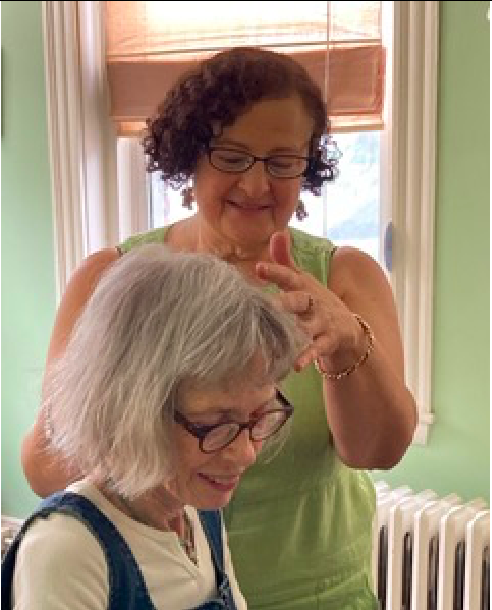
This is why when I work with a student, I activate their body wisdom with a gentle touch leading their body to reorganize itself into optimal coordination.
Students can learn to do this for themselves so, overtime, they are empowered to get sustainable results.
Sometimes, there is a deeper cause for their physical postural challenge. In this case, I use Embodied Energy work to complement the mind/body work.
And here is where it becomes confusing:
Because stretching brings temporary relief, it can appear to confirm the assumption it’s the solution for tight muscles. But if the habitual movement pattern remains unchanged, the tension inevitably returns — sometimes more intensely — eventually leading some people toward injections, chronic therapy cycles, or even surgery.
Aristotle wrote, “That which has become habitual becomes as it were natural.”
Centuries later, F.M. Alexander observed that when we misuse the body repeatedly, the habitual way begins to feel more natural than the natural way.
This is the crux of the issue.
When a dysfunctional coordination pattern feels normal, it becomes invisible.
And when it is invisible, it is rarely questioned.
The modern tendency to “drive” the body from the mind — telling muscles what to do instead of allowing intelligent joint coordination to unfold — reinforces this misunderstanding.
I have written about these inherited misconceptions of movement in both of my books because I have seen the long-term consequences in real bodies for over three decades. My intention is not to discredit other professionals. Most are working with the information they were given.
My intention is to restore awareness of something simpler and more fundamental:
The body already knows how to organize movement with efficiency and ease.
But when habits override design, strain becomes normalized.
CONCLUSION: Until we address the coordination pattern itself, we will continue treating symptoms. And many people will continue believing their body is the problem — when in fact, it is a learned pattern that can be unlearned.
Cécile Raynor is the author of “The Wise Way to Yoga” (2018) and “Body Wisdom Magic” (2025). She has been teaching for over 30 years. Her work centers on Integrated Functioning—the natural cooperation of all body parts and of body, mind, heart and spirit—grounded in the Alexander Technique and the Inner Coach Method™. She offers private sessions and group sessions online and in-person to assist people live with greater ease of movement and ease of being.
